April 30, 2006

[Rant] Media vs. Media Center

When I woke up yesterday, I took my shower, grabbed a Coke, checked my E-mail, and then sat down at my TV to watch the latest episode of "Mythbusters." My wife had left for a small part of the day, so my timing couldn't have been better.

Now, because I only watch a few shows and am rarely around when those shows air, I've got a Windows XP Media Center Edition 2005 installation on a computer hooked up to my TV that acts like a TiVo: recording TV shows, getting TV listings, et cetera. I also use it as a true media center. My pictures, music and movies are all on this one central machine.

Over the last few months, I've had to deal with a few inconveniences. Lots of TV channels have started using the broadcast flag, so not only have I been unable to keep some shows until I had time to watch them, but any that are copy protected can't be viewed from other computers in the house. But while inconvenient, I've been able to get around it via weekend reruns or other options.

But Saturday took the cake. I sat down to watch "Mythbusters," but before I could select anything, I noticed an odd error message on the screen.
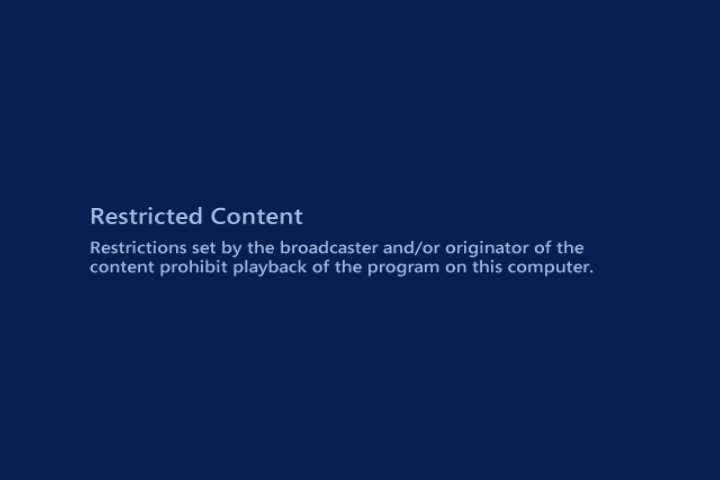
Restricted Content: Restrictions set by the broadcaster and/or originator of the content prohibit playback of the program on this computer.

I'm used to errors greeting me in the morning. My wife isn't very technically adept, so she'll usually leave errors on either her machine or the TV for me to troubleshoot in the morning. Fortunately, on a Media Center PC, it's generally easy enough to just hit the "Back" button on the remote to see what she was doing.
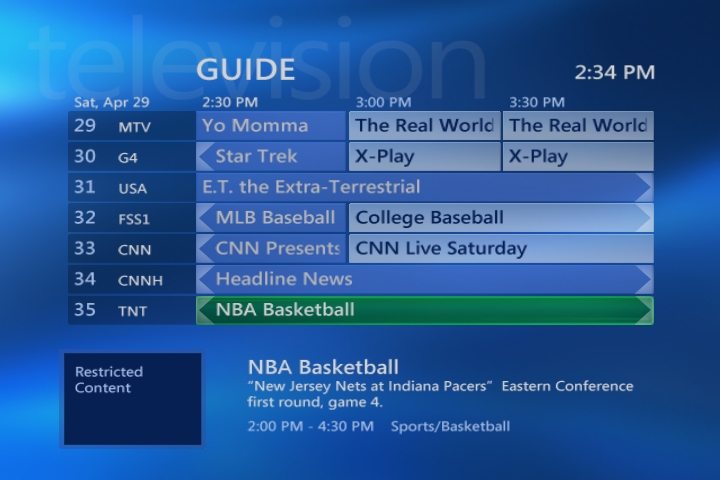
I'm restricted...from watching LIVE TV!?!?!?!

After hitting back, I noticed that she was watching TNT. I hit "OK" to select TNT again, and still got the "Restricted Content" message.

Now, it's one thing to prevent someone from recording a television broadcast, but it's something else to prevent someone from watching a live broadcast. What's even worse is that the signal they embedded to trigger the broadcast flag messed up Media Center so that if I switched to a different channel, I still had the "Restricted Content" message, but with the audio of the channel in the background.

Turning off my Media Center and turning it back on resulted in everything being okay until I changed to TNT, and then it all repeated itself.

This brings me to my point. Microsoft has been making a lot of concessions to big media over the last few years in an effort to get studios to use Microsoft DRM technologies for copy protection with some measure of success. However, Microsoft has now given these companies the tools to not only prevent unauthorized use of their content, but to actually prevent authorized use of their content. Heaven forbid that someone actually want to watch live television via their computer.

What kills me is that I'd most likely have a better end-user experience using technology that pre-dates the broadcast flag. I've got an older TV tuner card in another machine that not only ignores the broadcast flag, but gives me slightly higher image quality. Of course, that card doesn't work with Media Center...

So what are we as consumers to do? The Bush Administration and the FCC have pretty much proven that consumer rights are the last thing on their agenda. The senators for my state are too busy trying to get memorials for astronauts to actually do any work. The senators in my last state weren't any better, suggesting that media companies should actually be allowed to bypass due process and destroy people's computers while at the same time violating license agreements themselves.

I'm really at a loss.

[Personal] Negativity and letting go...

Those of you who know me know that in general, I'm a pretty calm person on the surface. The unfortunate reason for my calm exterior is that for several reasons, I always expect the worst to happen. I'm rarely disappointed that way.

Pessimism actually helps quite a bit with my profession. Generally, the pessimism of the quality assurance department acts as a dose of reality for departments that are, well, over-optimistic.

However, pessimism does have several consequences. Stress is perhaps the biggest side effect. When you are always dreading the worst, it's hard to see the small things that make you happy. Pessimism also affects how you are seen by others.

So I've been going over my goals for what I want to try for "SiN Episodes: Episode 2 (Tenative Title)," and I think the biggest goal is to try to scale back my pessimism.

I'm still going to look at things in the most pessimistic way possible when doing asset reviews for ESRB issues, especially given some events that occured during the creation of "Emergence." And I'm still going to be as forceful as possible when fighting for the consumer.

But I need to get to the point where I can seperate my professional pessimism from my personal views on life. In these days where a person's job can vanish overnight, television companies can tell your television not to air certain shows because your TV isn't "compliant," and parents would rather censor entire classifications of entertainment than actually act like parents, there is enough negativity in this world without me adding my personal blend of sulk.

I hope that by letting go of some of my negativity, I can open myself up to some more opportunities as well as find more ways to help others.

For example, while I may have had some negative experiences back with MGS, a lot of those experiences can really be traced to my own negativity. So why should I hold anything against them? They reflected my negative energies back at me in a tangible fashion, but I was still the originator.

I'm not getting rid of all of my negativity, however. Pure optimism is just as unhealthy, if not moreso. Keeping some of my negativity will keep me grounded in reality, which is right where I need to be.

April 29, 2006

[Industry] Thanks and Verification

First off, I'd like to thank Laura Crowley at Day 1 Studios (makers of the wonderful and unfortunately now-defunct MechAssault series of games) and David Pickett at New Boundary Technologies for sending out job information for those who were recently laid off from Indie Built. It sounds like Avalanche/Buena Vista in Salt Lake City has been trying to pick up a lot of people, and Ritual has also send information along.

For those who have been waiting for more verification to act, this is a post from someone who was laid off on their blog.

We're a small industry, and we need to look out for our own.

April 28, 2006

[Industry] Access Software, RIP 1983-2006

Access Software, one of the last great independent developers, finally met its untimely end the afternoon of April 27, 2006.

Access Software was founded back in 1983 by the late Bruce Carver and Chris Jones, and quickly rose to the pantheon of classic game developers, with classics such as the "Links" series of golf games, the "Tex Murphy" series of adventure games, and the "Beach Head" series of action games.

The cost of acquiring rights to golf courses escalated over the years while Access was competing with Electronic Arts. In order to keep the company alive and give "Links" a solid financial backing, the company was sold to Microsoft in 1999. (MobyGames incorrectly shows 1998.)

However, Microsoft Game Studios managed to strip the profitability away from the studio by eliminating the means that Access had used to keep their products low-cost. As a result, the studio did not have many profitable titles during its stay with Microsoft.

In 2003, there was a massive layoff at the studio, which Microsoft promptly denied to "Penny Arcade." Less than a year later, the studio was sold to Take-Two Interactive and renamed to Indie Built, Inc.

Access had about seventy employees left at the time of their untimely demise. If you know of a position that is available for someone in the area, let me know and I'll try to pass the word on to the appropriate people.

April 26, 2006

[Personal] Me against the Movies

I just watched "Final Fantasy VII: Advent Children," and I think I finally figured out why I'm so aligned with most gamers on games, but so completely off-kilter with most gamers when it comes to movies.

Games are generally about knowledge, learning and choice. "I know facts A, B, and C; from that I can learn item D; and that helps me make choice E." Games that violate previously learned knowledge tend to fare very poorly with most gamers.

Movies are generally about suspension of disbelief. "I don't exist in their world, I'm merely observing it from a safe distance."

Gamers tend to watch movies in cued-anticipation mode. "I have learned from cue A that when it occurs, action B will follow. Therefore, I'll prepare myself accordingly there." That's why you see all the gamers going on about the first siren scene in "Silent Hill (2006)", because it's the first time in the movie that the associated cue appears, and therefore the first time they are able to apply their knowledge. The momentary expectation and action are the primary drivers.

Cued anticipation works wonderfully for games. Most games give you a clue that X is going to happen so that you can properly react to it, like the creak on trapped chests in "Diablo," or tracers on bullets in most first-person shooters. The clue informs you as to how you should react, and you try to react accordingly.

General movie-goers tend to watch movies in anxious-anticipation mode. Cues can act as foreshadowing, but it isn't the action, it's the resolution that matters. The movie goers who went to see "Silent Hill" were more concerned with figuring out the Alessa/Sharon, trying to figure out how this was going to lead to a happy ending, etc.

Anxious anticipation works well when you have no pre-existing knowledge, because you spend your time gathering clues and trying to analyze them. It helps with the immersion because you're brain is active trying to figure things out.

So, why did I like "Silent Hill" when most gamers and most reviewers tended to loathe it? When I'm gaming, I follow the cues. When I watch movies, I only care about the ending. With that combination, "Silent Hill" was essentially made for me. It relied on having some base knowledge of the source universe to be able to decipher the conclusion, but it strayed enough from the cues from the game that I wouldn't have been able to use any of my learned knowledge from the gameplay to prepare myself for the future.

In short, it was a video game movie for fans of the video game that were willing to leave the game behind. Gamers kept picking up on the gamisms in there, expecting pop-ups like "You got the school office key," while the moviegoers were simply wondering what would be found as a result of finding the keys.

For the most part, I was able to leave the game behind. Only the last two minutes threw my gamer half into convulsions, and that was because everything that occured in those two minutes betrayed all of the knowledge that I had acquired previously.

Gamers were feeling their knowledge betrayed from the start, with Rose instead of Harry, the creatures from "Silent Hill 2" instead of the original game, Rose not having a clip-on flashlight, etc. Moviegoers were feeling off because of Christopher's search for Rose, the interdimensional aspect that was added to the town to support the last two minutes not really meshing with the remainder of the world knowledge presented to them, and the pacing wasn't exactly standard for horror flicks, but was established fare for the game.

This may not make a lot of sense to you. To be honest, it barely makes enough sense to me to write it...but at least I now know why I'm able to enjoy flicks that my gaming buddies seem to loathe with a passion normally reserved for cross-dressing Nazi pedophiles on acid.