August 3, 2006

[Ritual] Brains...

The hazards of having an employee who is obsessed with zombies...

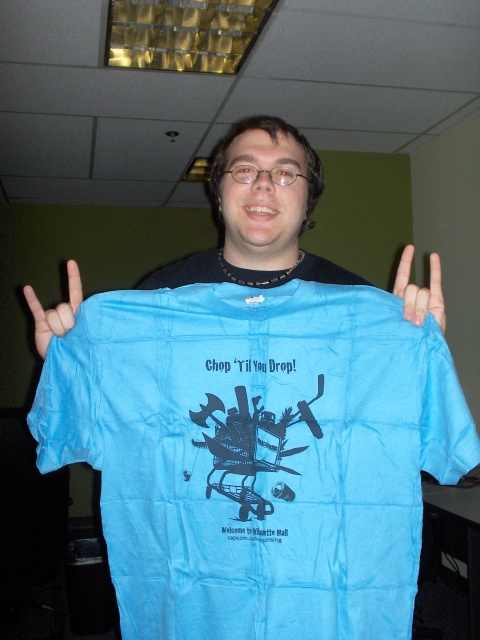
Joel holding his new pride and joy, the promo T-shirt for 'Dead Rising'

I dread next week.

August 2, 2006

[Movies] Snakes on a Viral Marketing Plane

On a lighter note...

The "Snakes on a Plane" viral marketing machine has just kicked into overdrive.

[Misc] Sigh...

I was trying to come up with a decent post for number 600. It isn't often that anything hits 600 installments. Most webcomics tend to falter before they hit 100, and most blogs have faltered within a single day.

So I wanted to do something special. I wanted to look back at the ups and downs of posting over these last few years. I wanted to show the positives of knowledge sharing, show the value of public debate, and show that through the open flow of information, the world coule become a better place...and then I saw this post over at Ars Technica in relation to my recent complaints that pirates were asking for support.

You don't understand! It's the developers who are evil and trying to defraud consumers, and the pirates are just fighting for their rights.
Wow. I'm stunned.

I'm stunned by the ethical leap that someone would have to make to even utter that statement. Of course, I've been stunned a lot lately by ethical leaps and lapses.

I wouldn't be surprised if this was one of the same people talking about molesting the pre-teen female star of "Lazytown." (If you haven't seen the posts from one of these wonderful examples of humanity, just read the comments on one of the videos and weep for the future of humanity.) Following his logic, it seems that children are evil and he'd just be fighting for his rights as a pedophile.

I spent a good part of the morning discussing region locks with Ozymandias over at Microsoft because I felt that region locking caused more harm than good. (I'm working on a post for that topic, but the fact that I was bringing it up at all is the point for now.) I pointed to areas where region locking led to either financial issues for the platform holder, additional support issues for the publisher, and potential lost sales for the developer. I also brought up my experiences as a consumer where I've tried to import items as well. It was a very lively discussion, but at each point, we were attempting to balance the wants and needs of every member of this community: platform holders, publishers, developers and consumers.

While we agreed to disagree, we all agreed that in the end, all of the parties involved were gaining something while losing something else. It wasn't a zero-sum game for everyone (some parties were gaining more while others were losing more), we were discussing it trying to find some sort of equilibrium in the gaming ecosystem.

The attitude from the poster above is not the attitude of a contributor, but that of a parasite. He wants to contribute nothing, but instead reap all the benefits that he can. Due in part to the growth of broadband and the social acceptance of peer-to-peer networks, this community of parasites has grown significantly faster than the rest of the gaming community.

I'm not rich. I make enough to keep my wife and I in our one-bedroom apartment in Dallas and buy a game about once a month. I'm not naïve. I expected there to be some level of piracy because of the history in this industry, but I did not expect the level of piracy that we experienced, nor did I expect the severe amount of chutzpah that the parasites had.

Parasites in nature have a purpose. They feed off of larger entities, only to eventually become food themselves. However, nobody can feed off of the pirates in the gaming ecosystem. The many "benefits" that most pirates claim to produce in the ecosystem are only benefits for the pirate.

I don't know how to end this. I really don't. So I'm just going to stop, say thanks for sticking around for 600 posts, and get back to wondering exactly where this ecosystem fell apart.
August 1, 2006

[Games] I'm Pro-"Games For Windows"

Now, for the last week or so, I've been fairly "doom and gloom," but I want to call out some positives coming down the path...namely, Microsoft's "Games For Windows" push.

"Games for Windows" has been around for awhile, and it essentially is a means for developers to get a logo on their machine that says, "Yes, I will work on Windows." That's it. With the upcoming arrival of Vista, however, "Games for Windows" is going to take on a whole new level.

"Games for Windows" consists of two parts: the logo and the push.

The logo program has been around since Windows 95, but started getting more of a games focus around mid-2004, and enforcement for use of that logo has been getting more strict as time goes on. Essentially, there are a set of rules that developers need to follow to get the "Games for Windows" logo.

Most of the requirements are fairly straightforward. Some can get waived depending on your distribution platform, although those waivers are going to be going away as well.

The main goal is to try to get games to have a standard way that they work with Windows. They want faster installs. They want save games to go into your "My Documents" folder. They want file access to occur according to a proper security policy. In other words, they're trying to get a little bit of console TCR's into the PC business, and that has to be a good thing from a support standpoint.

A secondary goal is to make it so that Microsoft has to create fewer shims to keep games working in newer versions of Windows, but that's beyond the scope of this discussion.

The other part of "Games for Windows" is the push. Remember when I was saying that we have to pay graft, er, market development funds to stores so they won't bury us with the rest of the products that never sell? Well, Microsoft is essentially saying, "Hey, you make things easier for us, and we'll help out by paying the graft for you."

Microsoft is going to be dumping loads of money out there, trying to show that Vista is a better OS for gaming, trying to get people to upgrade their systems to handle Vista, get Vista sold to more people, etc. And games help sell upgrades. If Microsoft can point to a few shelves as well and say, "And these games will work great with Vista," hey, all the better, right?

Starting with Vista, the "Games for Windows" logo is going to be a cherished item. "Look, these guys made sure their game worked with Vista and I'm not going to need to worry about 94 'user access protection' dialog boxes popping up every time I try to save." If you care about the experience of your users, pay attention to this closely...if your user has to enter a system password just to save their game, chances are that they aren't going to be happy with you.

In short, this is going to be a good thing. It will reduce support costs, help reduce the amount of money that it takes for PC titles to break even (slightly), and provide a more consistent experience for the end user.

Could we ask for more? Sure...but this is a great start.

[Games] Why $40 million?

Okay, now it's time to look at third-party deals, and why it takes $40 million in retail sales before the developer sees a penny above their advance.

Let's say that Publisher A signs Developer B to make a game for a $2 million advance against earnings. Developer B is going to get 10% of net on wholesale.

Publisher A gives the $2 million to Developer B over the course of the game being developed to cover expenses, etc. This puts Developer B's current earnings on the game at -$2 million. (They've received $2 million against their earnings, so they're in the negative.) At this point, the publisher is also at -$2 million on their balance sheet. (This part is important...)

So, the game is done, and Publisher A starts their marketing push, manufacturing, etc. As you may remember from before, this puts the publisher at -$15 million total.

At first, all money that comes in from the title goes to the publisher so they can recoup the $15 million loss they have incurred. Why doesn't any go to the developer? Because the money is against net earnings, and the $15 million is expenses directly related to the title that the publisher has incurred.

Once the publisher has earned back their $15 million, 10% of each copy sold at wholesale starts going towards the advance against net profits. So if this is one of those games that was selling like gangbusters, and the wholesale price is still $40, that means that for this example $4 out of each unit would be going towards the -$2 million hole that the developer is currently in. Most games have already undergone a price drop at this point, so you're looking at between $1.50 and $3 per unit going towards the hole.

In practice, it takes about $40 million in retail sales to refill the $15 million hole the publisher is in and the $2 million hole the developer is in.

This is the primary way that day-0 warez hurts developers. Initial sales are crucial on any title. The more sales before that first price drop, the more likely that the publisher will break even early and the more likely that higher dollar amounts will be applied to the developer advance. The longer it takes for the publisher to break even, the harder it is for the developer to earn out against their advance. Every sale taken away early on makes it harder for the person behind the title to actually make any money off of it.